


Welcome to the Fulton County Courthouse
The Fulton County Courthouse has stood at the heart of Rochester, Indiana, since 1896, serving as a center of government and as a landmark of our community’s history and pride. With its striking limestone architecture, detailed carvings, and the well-loved lion statues guarding its steps, the courthouse tells a story of craftsmanship, resilience, and civic spirit.
This self-guided walking tour invites you to slow down and take a closer look. Along the way, you’ll discover fascinating details about the courthouse’s design, learn about the people who brought it to life, and uncover stories that connect our past to the present. Whether you’re a history enthusiast, an architecture admirer, or simply curious, this tour will help you see the courthouse in a new light.
In the Beginning
The current Fulton County Courthouse is actually the third to serve our area.
The very first was a two-story oak log structure, located just west of the present courthouse square. The modest building measured just 20 × 24 feet., and was constructed in May 1837 by Ebenezer Ward. The total cost of construction was $600.
As the county grew, a more substantial courthouse was erected and stood on the site of our current courthouse square. It was designed by Joseph Miles and built by Henry Kent, costing around $6,000. It featured a two-story brick and stone Greek Revival style structure, which was popular for official buildings prior to the Civil War. It shared the square with a brick jail and a bandstand. This building stood proudly for fifty years, until the community again outgrew it. It was torn down in 1895 to make way for the current building.
Include photo of old courthouse 1
Include photo of old courthouse 2
The Present Courthouse (1896-Today)
By the 1890s, Fulton County had outgrown its second courthouse and needed a building that reflected its prosperity and permanence. In 1895, plans were drawn for a grand new courthouse. The cornerstone for the new courthouse was laid on September 19, 1895 by the Grand Master of the Indiana Masonic Lodge, and construction was completed in 1896.
The courthouse was designed by A.W. Rush & Son, architects from Grand Rapids, Michigan, and built by contractor J.E. Gibson of Logansport, Indiana. Constructed from locally quarried limestone, the building cost approximately $76,073—a major investment at the time.
featuring a commanding clock tower with a pyramidal roof, the structure stands four stories tall and occupies an entire block in downtown Rochester
The courthouse is a striking example of Richardsonian Romanesque architecture, a style characterized by heavy stone walls, rounded arches, towers, and dramatic rooflines. The four-story structure occupies an entire block of downtown Rochester, and features a commanding clock tower and pyramidal roof. At the time of its completion, the Fulton County Courthouse was the tallest courthouse in Indiana, with its tower reaching approximately 120 feet—surpassing that of nearby Pulaski County (106 ft) and only outdone by the much taller Rush County Courthouse (196 ft) built just two years later.
Inside, the courthouse features a cross-hall plan with three public levels and an attic. At the time, it housed courtrooms and county offices, serving as the central hub for government and civic life. Over the years, it has undergone updates for safety, accessibility, and preservation, but its historic character remains intact.
In 1896, an unofficial dedication ceremony was held, to mark the completion of the new structure. It was well attended, with reports that people came from hundreds of miles away to see the history-making building. However, there are reports that the ceremony was held with some satire--a local newspaper article at the time stated that the ceremony was necessary "so the taxpayers who must foot the enormous bill...may become more familiar with their pets" (referring to the 10 stone lion statues).
The courthouse is recognized as a landmark of Fulton County and was listed on the National Register of Historic Places in 2000. On January 31, 2002, a rededication ceremony was held to commemorate significant renovations to the courthouse. Today, it continues to function as the seat of county government while also standing as a proud symbol of Rochester’s history and community spirit.
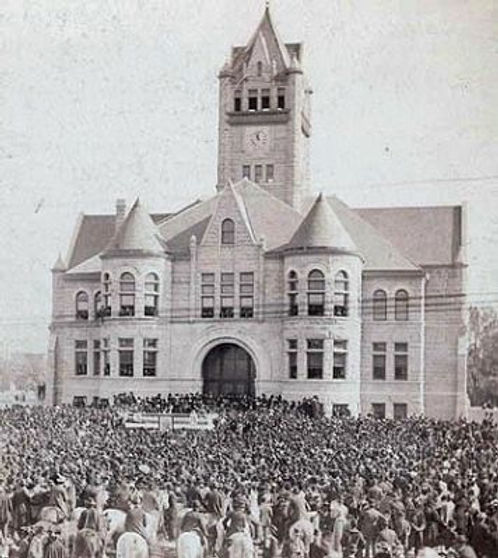
Fulton County Courthouse, 1896. Most likely during the dedication ceremony.
Source: Indiana Historical Society
photo now
Photos of the view from the clock tower
Photos of the woodwork inside the courthouse
Picture of the rededication plaque
Courthouse Lions
Perhaps the most beloved—and sometimes most debated—features of the Fulton County Courthouse are the four carved limestone lions that guard its entrances.
.Installed in 1896, the lions were sculpted by a German-speaking carver named Hedrick, made on-site from massive blocks of the same Bedford limestone used for the building itself. They cost a total of $1,600 to complete (roughly $160 per lion), Their imposing size and fierce expressions were meant to symbolize strength, justice, and protection.
At the time, however, not everyone was fond of the lions. Many taxpayers were angry at the courthouse’s cost, which soared well beyond the original budget. To ease criticism and help the public “warm up” to these stone guardians, the local press encouraged giving the lions names. The idea was that if citizens felt more personally connected, they might become less resentful of the expense. Over time, the lions became endearing mascots of the courthouse rather than symbols of controversy.
Today, the lions are a favorite photo stop and a distinctive part of Rochester’s identity. Generations have grown up walking past them, posing beside them, and treating them almost like members of the community. Their silent watch has spanned more than a century of Fulton County history, making them as iconic as the courthouse itself.

Front and Center: the lion guarding the (n/e/s/w?) entrance, named President of the Board. Behind him stand Merrit (after Merrit Baker, the county attorney) and Henry ( after Henry Bibler, Rochester’s town attorney).
Photo of Maria with caption including her name/story
Photo of Rush caption including it's name/story
Photo of Red with caption including it's name/story name
Photo of Gib with caption including it's name/story
Fun Fact: The courthouse is part of a trilogy!
The Fulton courthouse is not a one-off—A.W. & E.A. Rush designed a recognizable trio of Romanesque courthouses across north-central Indiana:
-
Pulaski County Courthouse, Winamac (built 1894–1895) — three-story building with a 106-foot clock tower..
-
Fulton County Courthouse, Rochester (1895–1896) — four-story, 120-foot tower, distinguished by lion sculptures.
-
Rush County Courthouse, Rushville (completed 1896) — the most monumental of the trio, featuring a 196-foot clock tower and elaborate Romanesque detailing.
The designs share core characteristics: rock-faced limestone, massive arches, asymmetrical layouts, and an impressive tower over the crossing. Yet each adaptation reflects a growing scale and ornamentation—from Pulaski’s simplicity, to Fulton’s balance, to Rush’s grandeur.
However, one detail makes the Fulton County Courthouse stands out from its sisters: the lions. While Romanesque buildings often featured carved faces, gargoyles, or decorative flourishes, animals were rarely included—and among the more than 60 Indiana courthouses built in the 19th century, none has anything quite like Fulton County’s lions. Their presence makes this courthouse unique not just in Indiana, but in the entire Midwest.